Our History
Henry Ford once said, “Coming together is a beginning, staying together is progress, and working together is success.” This is what happened over the course of historical friendship between the U.S. and Afghanistan. The U.S. always has remained an important partner for Afghanistan for almost 100 years. This friendship has shaped strong bilateral relationship and strengthen Afghanistan’s capabilities to improve the lives of the Afghan people.
As a partner, the U.S. always was committed to investment in different spheres of our government and specifically helped Afghanistan improve its security, governance, institutions, and economy.
Aviation is part of this milestone in Afghanistan history. On 27 June 1956, Pan America World Airways signed a historical partnership agreement with Ariana Afghan Airlines and purchased a 49% stake in the company. At that time, both the U.S. & the Soviet Union had interest in entering Kabul’s business through air transport & some other development agreements. The agreement with the top-notch and first-class airline of the world, Pan Am at that time brought some great opportunities and hopes for the Afghanistan aviation industry as well as its air transport &, in its most swift action Pan Am took all responsibilities for operational and technical parts of Ariana Afghan Airlines.
On 3rd June 1956, Ariana Douglas DC-4, a four-engine propeller-driven airliner with a group of Afghan crew reached New York and professionally trained by Pan Am then came back to Kabul in order to start Hajj flights to Mecca KSA. At that time, the DC-3s were used for internal domestic services that connected Kabul to Herat, Kandahar, Kunduz, Mazar Sharif, and Maimana. New Delhi was connected to Kabul via the Indian city of Amritsar and Karachi, the Pakistani port city was connected via Kandahar.
The DC-4 was used to connect Kabul to Teheran, Beirut, and Damascus via Kandahar where American economic development funds were used to build a modern airport and terminal facility.
On 11 September 1959, Ariana initiated services to Europe which used the DC-4 on services to the Turkish capital of Ankara via Beirut. The flight then continued on to Prague and then put a stop in Frankfurt. At that time, they had to replace its DC-4 with a larger DC-6B since the European tourists were attracted to fly the "Marco Polo Route" to Kabul.
The airline soon knew that it was more profitable for the DC-6B services to bypass Kabul and instead fly Kandahar to New Delhi. Unfortunately, political instability in the region in the 1960s triggered the termination of services to Karachi and the services that connected Frankfurt to New Delhi could only be flown twice a month soon after, European services were canceled altogether with Ariana's westernmost destination by 1962.
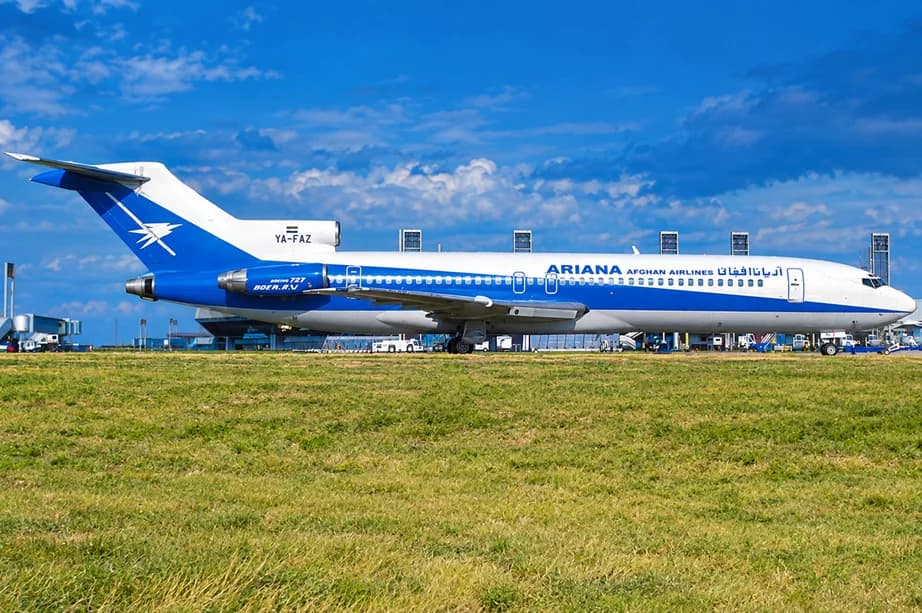
On 1963, American development fundraisers came back again. As a result, Ariana got a second Douglas DC-6 and two ex-Pan American Convair CV-340s to replace the DC-3 on the domestic services. A third CV-340 was purchased from Allegheny Airlines and this enabled a return to Karachi via Kandahar as diplomatic relations between Pakistan and Afghanistan solved. In July 1965, Ariana accessed DC-6 services to the Uzbek capital of Tashkent. Simultaneously, services to Europe kicked off with DC-6 services from both Kabul and Kandahar to London Gatwick and had one stop only in Beirut and Frankfurt. In April 1968, Ariana bought its first jet equipment with a Boeing 727-100 which replaced the DC-6s on the European services. The route to London was rearranged to route via Teheran, Istanbul, and Frankfurt. Due to some political changes in Afghanistan geopolitical areas, Afghan officials had to exclude Pan Am out of domestic operations. Pan Am still eagerly had interest in Ariana international operation since they were sold Ariana a Boeing 720B on a very reasonable deal something pretty much like a gift in May 1973.
During this golden age once again, political instability warned Afghans with some severe chaos. Then a series of coups followed starting in 1978, but regardless of this, Ariana launched Douglas DC-10 Series 30 services with a single aircraft in October 1979 on its services to London which could now be served nonstop.
On 24 December 1979, the Soviet Union invaded Afghanistan and that ended Ariana's operations. The two 727s and DC-10 were parked and eventually DC-10 sold off due to some political pressure in 1985. During instability in Afghanistan unfortunately a tragedy struck in December 1988, when Pan Am Flight 103 was destroyed by a terrorist bomb over Lockerbie, Scotland, killing 270 people in the air and on the ground and it was the first warning for Pan Am and then due to some other bankruptcy this airline ceased its operations. Civil war started and ruined Afghanistan. till late 2001, Ariana’s operations were limited or suspended in brief.
Following the Soviet invasion and the subsequent civil wars, Ariana was severely affected. However, in (1996), Afghanistan once again entered what came to be regarded as a golden era. With the return of the first Islamic Emirate of Afghanistan, Ariana purchased four aircraft, and a Boeing 747, could not be delivered due to sanctions and restrictions that prevented the payment of the remaining balance.
Using these newly acquired aircraft, Ariana Afghan Airlines reactivated all its previously suspended domestic and international flights, including Saudi Arabia and Dubai, and resumed its regular flights operations.
This was the only golden era for both Afghanistan and Ariana during which the airline was able, alongside its international services, to transport all Afghan pilgrims to Saudi Arabia on its own aircraft and bring them safely back to the country.
Unfortunately, when the US invasion of Afghanistan began in (2001), all of Ariana Afghan Airlines’ aircrafts were targeted and destroyed by the enemy.
After a generous gift of three A300B4 aircrafts from the Indian government, Ariana started flying again in December 2001. The flights resumed to Frankfurt but in March 2006 the EU banned Afghanistan Aviation industry from flying into EU airspace over safety issues and that ban has continued until today.
Pan Am currently just has an international flight academy in Miami Florida USA. Recently, three young and talented Ariana Afghan Airlines flight crew went to Miami, Florida, where the Pan Am International Flight Academy is located and after passing successfully of their ATP-CTP training, FAA written test, FAA check rides and taking their official ATPL FAA licenses from the Federal Aviation Administration USA in the hope of reviving back those golden age memories came back to Afghanistan and currently working as B737 Pilots for Ariana Afghan Airlines.
In fact, partnership is the key ingredient for success. Airlines, governments, companies and even suppliers along the value chain must work together to get satisfaction and global credibility. This is the story of Ariana Afghan Airlines, the oldest and most well-deserved airline in Afghanistan history and we tried to narrate all that untold stories and uncover all those historic memories of Ariana Afghan Airlines and Pan American and the stability of the great friendship of the U.S and Afghanistan.